Behind the pictures
How Salon is made
Salon is made by one person. The app is the small part. Most of the work is choosing the pictures, and this is how that is done.
Why it exists
I have a Samsung Frame with an Apple TV plugged into it. The art is the whole point of the Frame, and Samsung charges a subscription for it. That annoyed me enough to build an art mode for the Apple TV myself. For a while it only ran on my own television. Salon is that app, finished.
It starts with the museums' records
Museums have put millions of works online for anyone to use, and each publishes them differently: the National Gallery of Art as a set of spreadsheets, the Met one object at a time, others through search services. So I wrote a tool, which I call Curator, that reads each collection into one database. So far it has read 145,864 records:
- National Gallery of Art58,103 records
- Art Institute of Chicago37,939 records
- Cleveland Museum of Art17,544 records
- Smithsonian Institution10,156 records
- Nationalmuseum, Sweden5,103 records
- Rijksmuseum4,834 records
- NASA2,889 records
- The Metropolitan Museum of Art2,357 records
- SMK, National Gallery of Denmark2,026 records
- U.S. Geological Survey185 records
Salon is not affiliated with, endorsed by or sponsored by any of these institutions. It uses the pictures they have made free for anyone to use.
Most of it cannot hang on a television
A television is wide, lit from behind, and usually seen from across a room. Most of what a museum holds is none of those things. So before I look at anything, Curator sets aside what cannot work:
- 113,594 upright or nearly square. A television is 16:9, so a portrait would lose its head and its feet. Anything narrower than 1.4 to 1 is set aside.
- 2,275 too wide, past 2.1 to 1, which would lose both ends.
- 1,643 too small: under 1,600 pixels across, so it would have to be blown up more than twice to fill a 4K screen.
- 1,504 backs of sheets and fragments: the other side of a drawing, a detail, a scrap.
- 669 too faint. Contrast is measured on the picture itself. Pencil studies are the usual casualty: from across a room they are a pale grey rectangle.
![Paul Gauguin, Figure Seated on the Ground [recto]](/assets/img/made-faint-1200.webp)
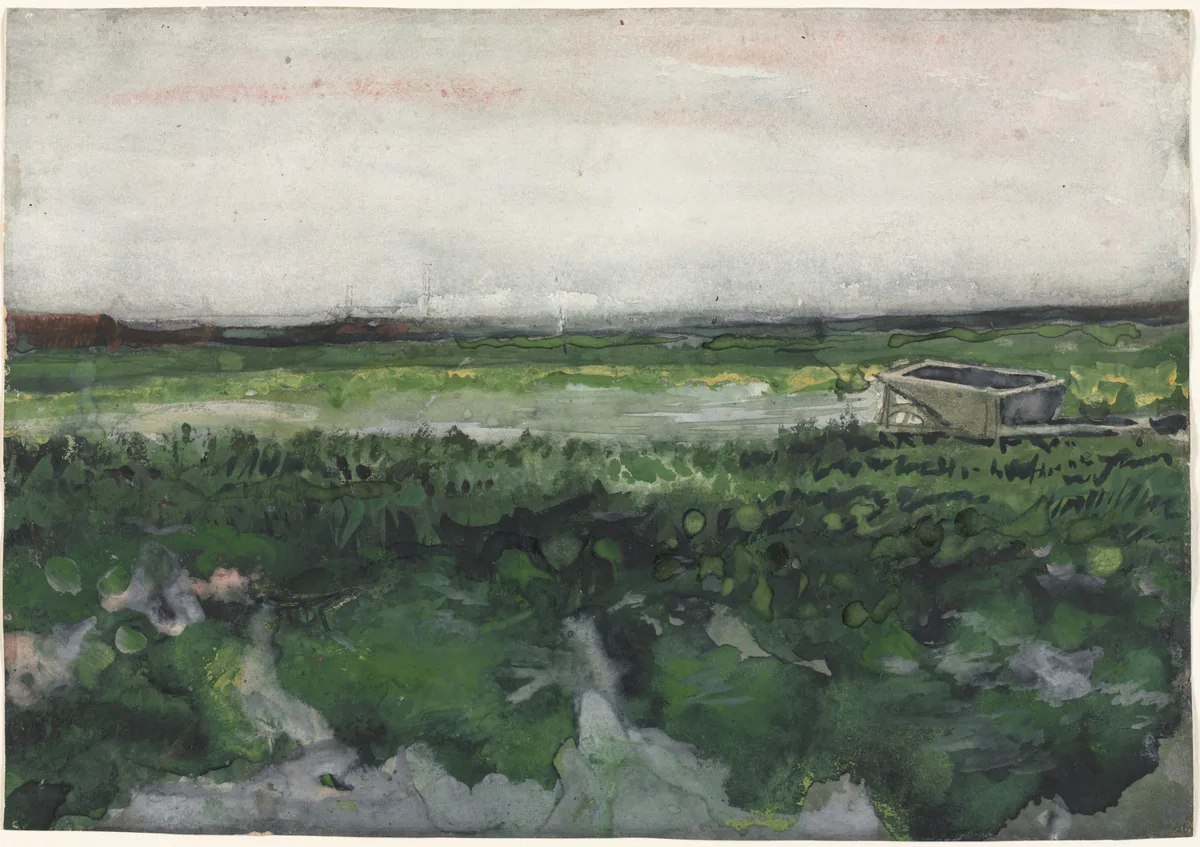
A drawing needs a contrast of at least 0.42 to pass; a painting, which is seldom the problem, 0.28. The checks only sort. They never delete anything, and I can overrule them, because some paintings are meant to be hazy.
Then I look at every one
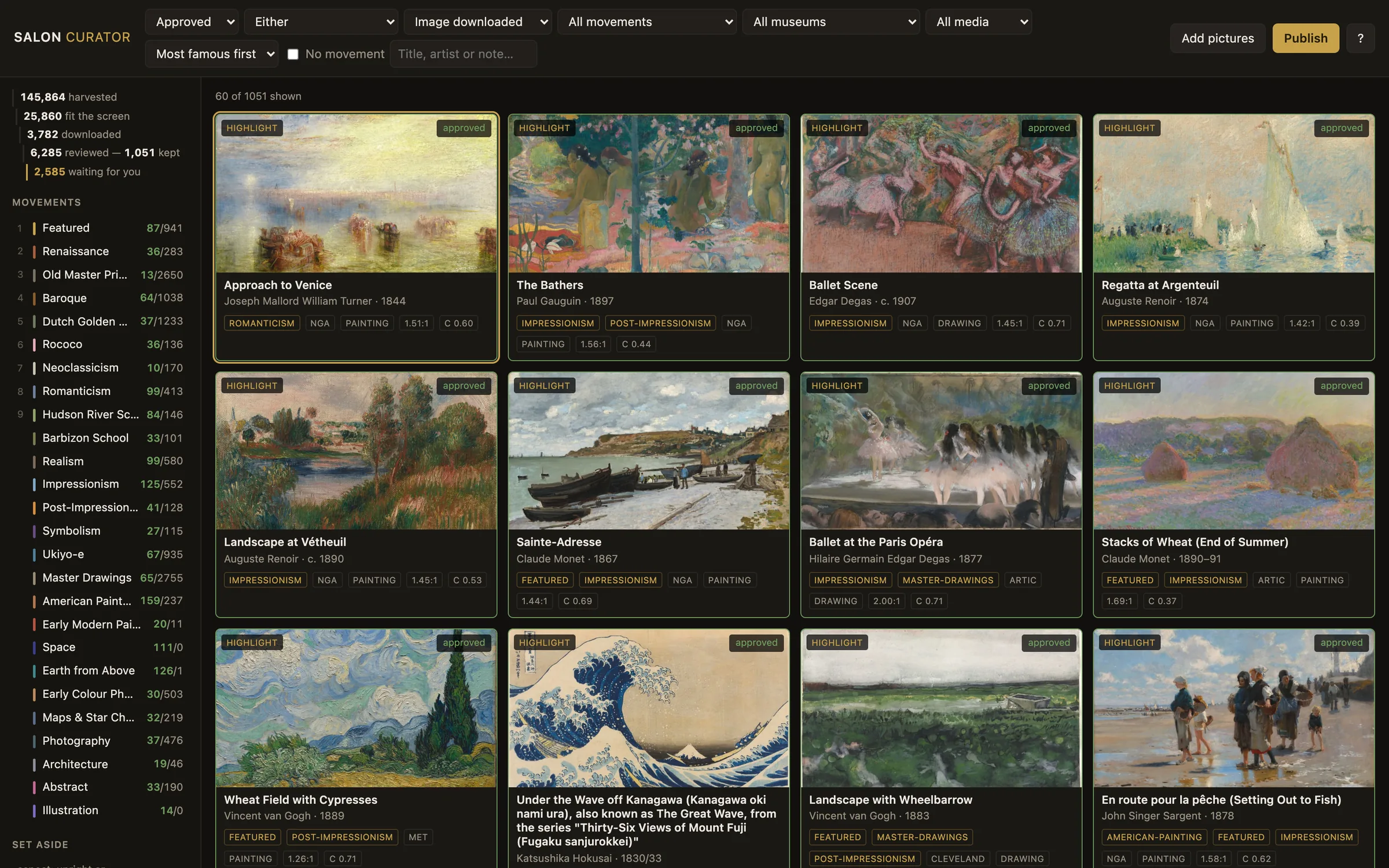
What is left goes into Curator's queue, most famous first, shown the way the television will show it: every tile is the 16:9 crop, not the whole picture. I go through them with the keyboard, A to approve and X to turn down. So far I have chosen 1,051 and turned down 5,234. A picture has to read from across a room and sit well in a living room, and most do not.
Choosing what to cut
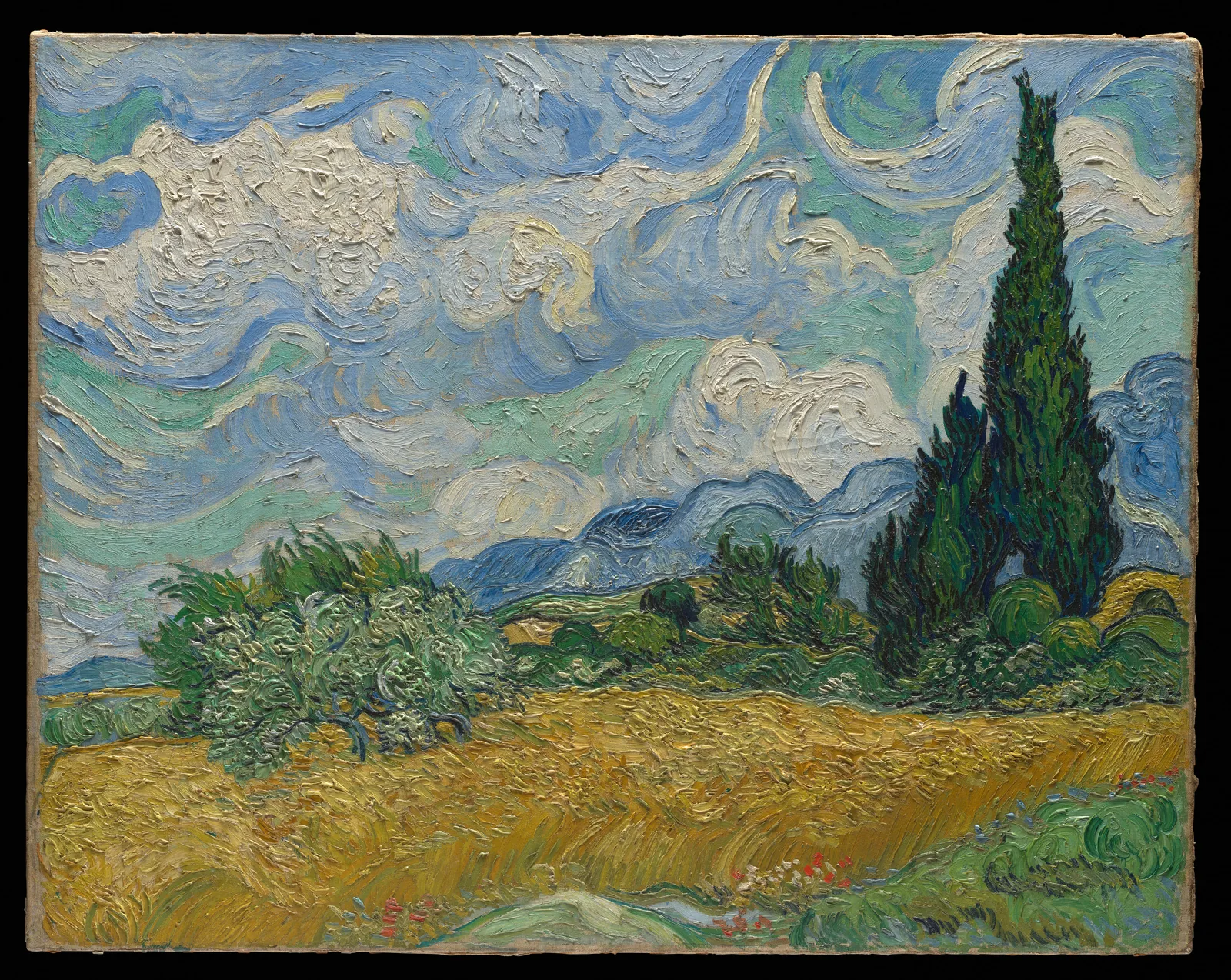
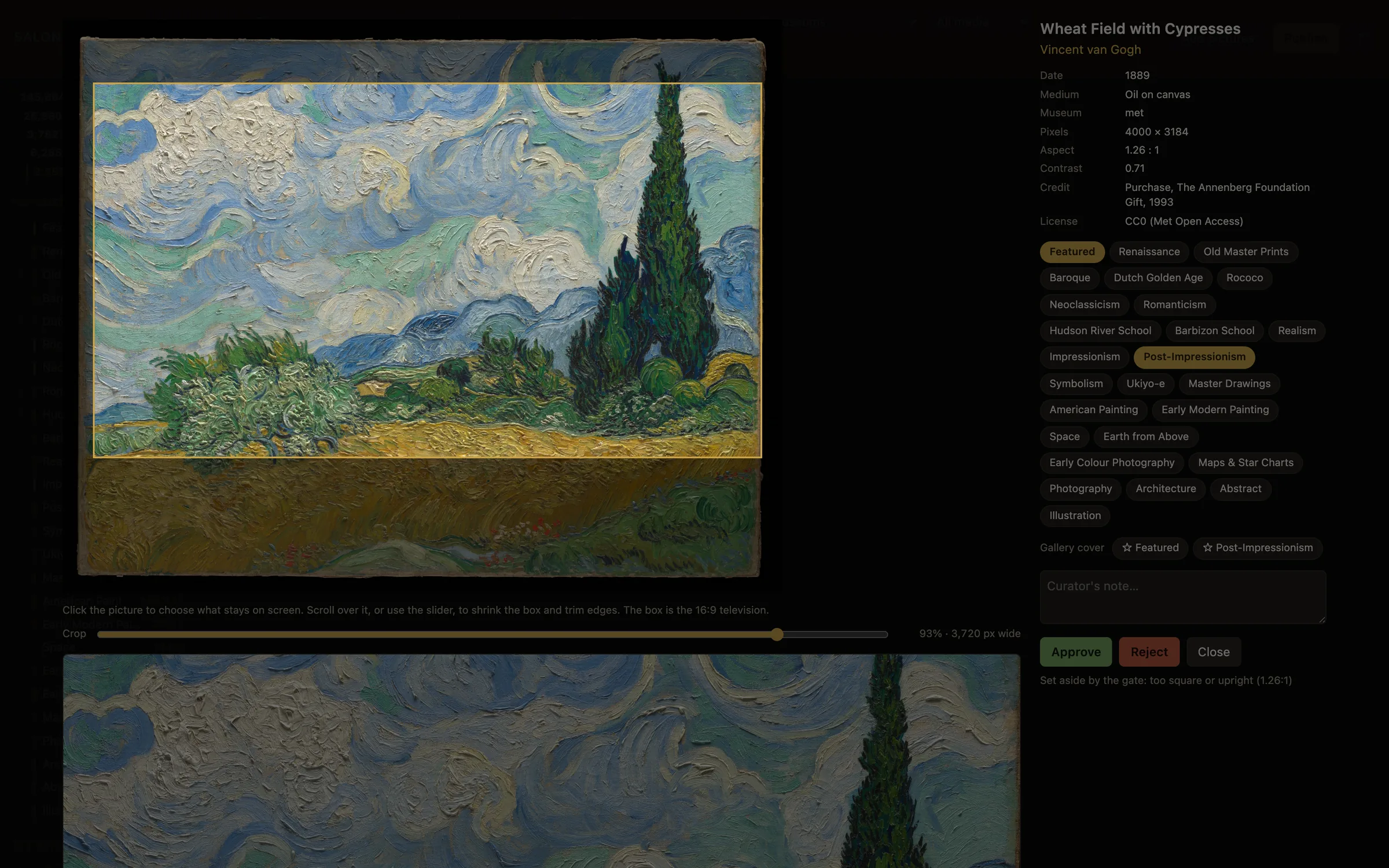
Almost nothing in a museum is the shape of a television, so almost every picture loses something, and the only question is what. Van Gogh's Wheat Field with Cypresses is 1.26 to 1. To fill a television, about 34% of its height has to go.
In Curator I click the point to keep, a face, a horizon, the sail of a boat, and the 4K version is cut again on the spot, so I am judging the actual result rather than a guess at it.
Checking copyright
A museum marks a work free to use under its own country's law. Salon is sold in Europe too, where a work stays protected until 70 years after its artist died. So Curator reads every artist's dates and sets aside anything by an artist who died after 1955. That is why there is no Hopper, O'Keeffe or Warhol in Salon.
Pictures from elsewhere
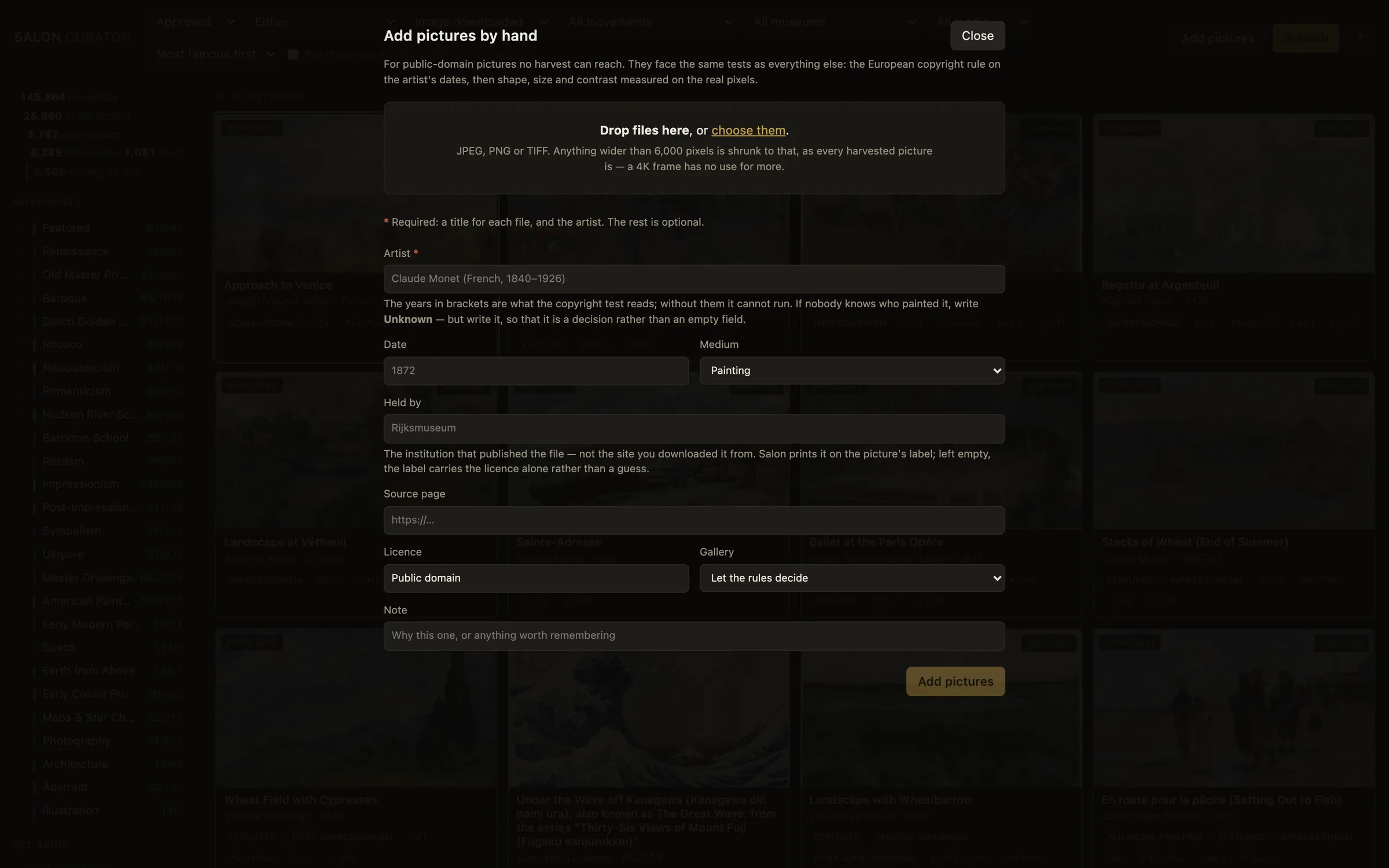
Some great paintings belong to museums that publish no open images of their own. For those, Curator can take a public-domain copy from Wikimedia Commons, but only a file Commons records as not copyrighted, and the label in Salon still names the museum that holds the painting. A few photographs come from Unsplash, under their photographers' own licence, and their labels say so. I can also add a picture by hand, and it goes through exactly the same checks.
How the pictures reach your TV
When I press Publish, Curator writes the whole collection into a single catalogue file of 559 KB, and the pictures, already cut to 4K, go up to Cloudflare. The app downloads that one file, keeps a copy, and works offline from then on. There is no account, and the app sends nothing back about what you look at.
Made by one person, with help
Salon is a one-person project, and was created with a mix of Swift code written by myself and Claude. The choosing was not: every picture in Salon was looked at by me.

An Apple TV app. On your Apple TV, open the App Store and search for Salon Museum Art.